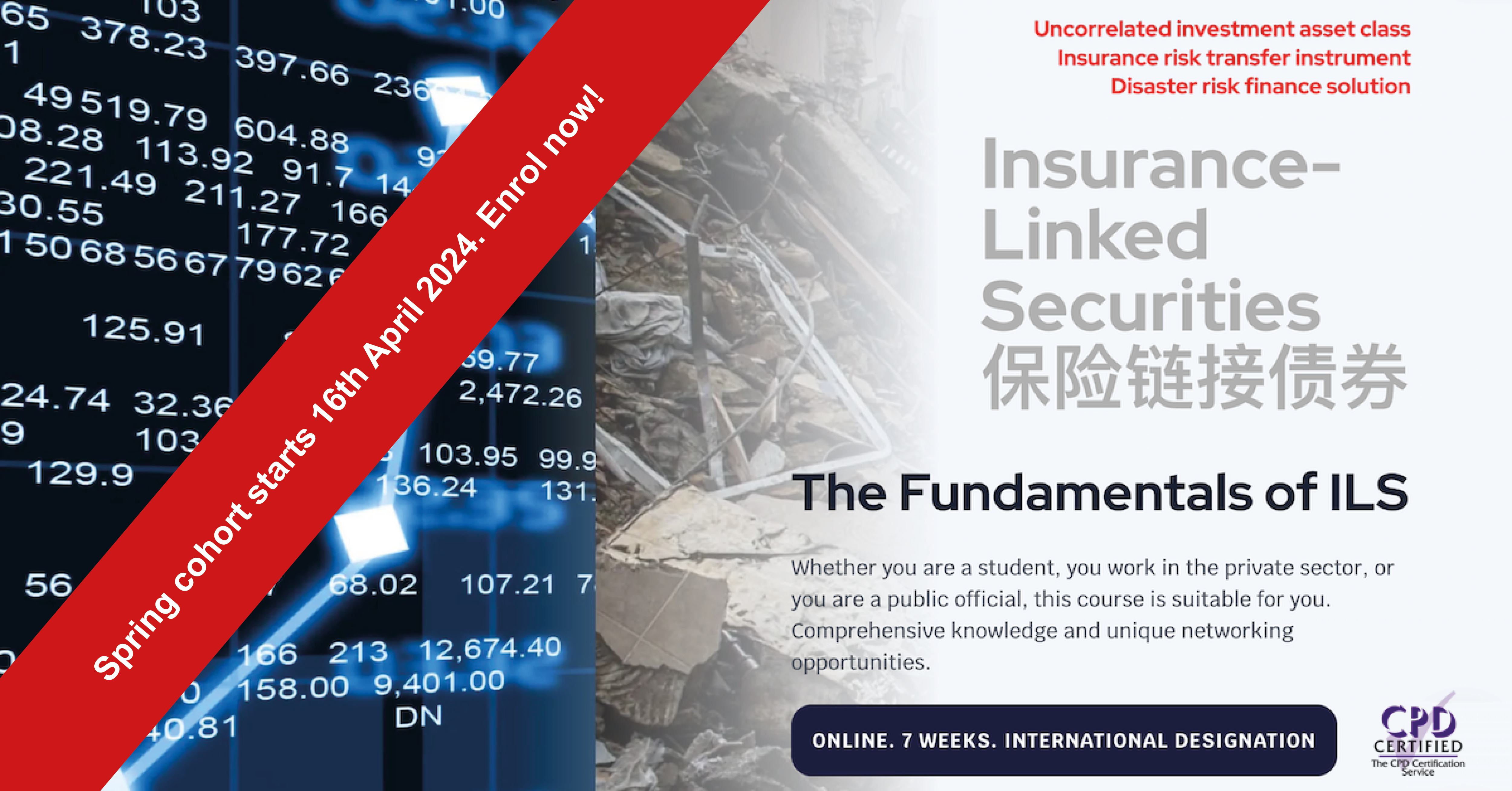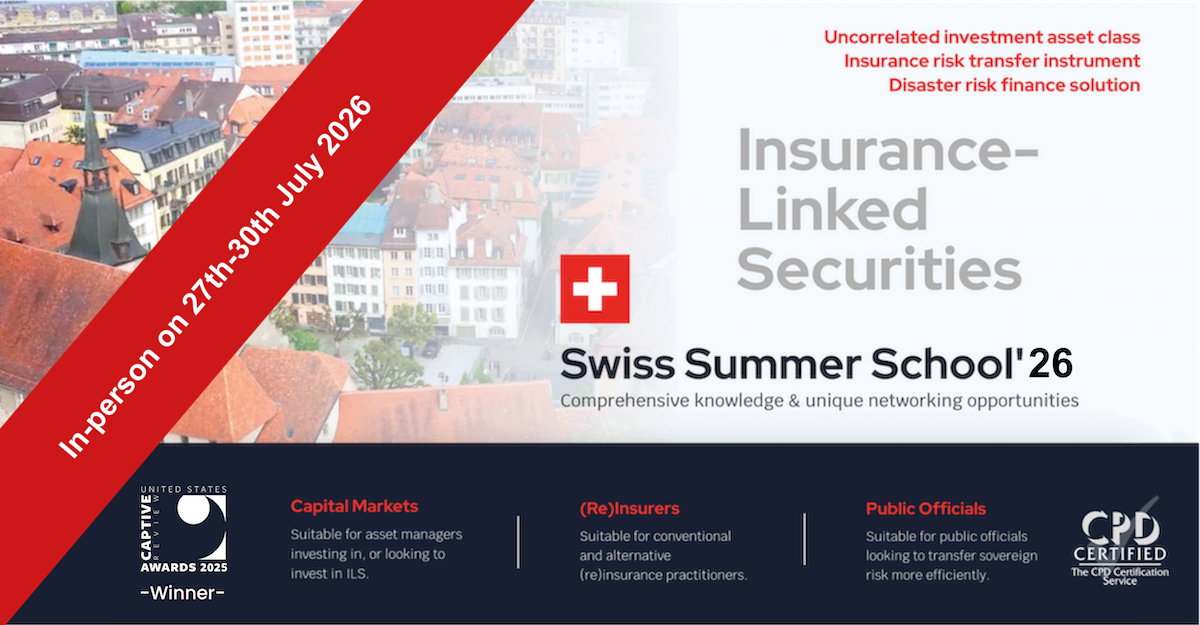
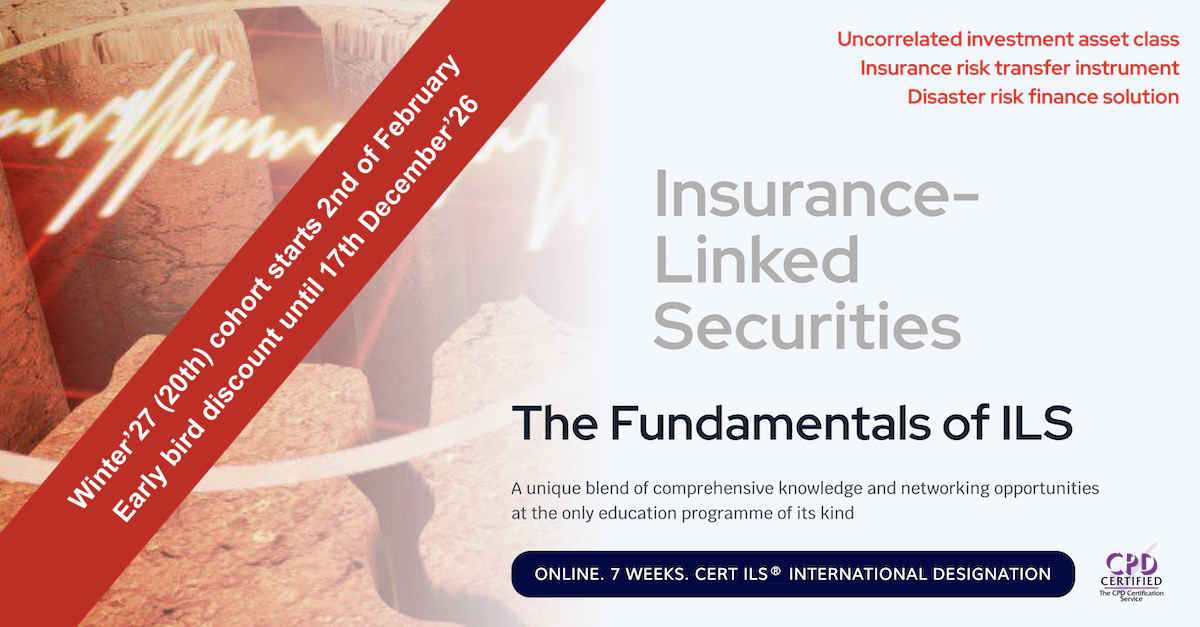
Since its inception in Autumn 2021, our Insurance-Linked Securities (ILS) Education Programme has become a unique, globally recognised initiative. With more than 120 alums from 51 countries, it remains the only dedicated executive education programme focused exclusively on ILS. We provide participants with essential knowledge and practical skills to thrive in the evolving intersection of (re)insurance and capital markets. This convergence has become increasingly important in managing modern global risk.
The pace of market developments in Alternative Risk Transfer (ART) inspired us to create a comprehensive ILS education programme, designed to examine ILS from three critical perspectives:
- As a risk transfer solution for (re)insurers seeking alternative capacity and capital efficiency;
- As an investment asset class offering uncorrelated returns with strong impact investing, SDGs & ESG alignments;
-
As a sovereign disaster risk finance mechanism for emerging markets
Over the past four years, we’ve delivered 16 online cohorts and introduced an in-person Swiss Summer School, offering participants the opportunity to network with global industry leaders and UN agencies while exploring advanced content. Our alums represent a diverse spectrum of the global ILS ecosystem, including professionals from major (re)insurers (32%), brokers (13%), asset managers and investment banks (11%), sovereign risk pools (9%), development institutions (8%), and regulatory bodies (4%)
The programme spans three sequential 7-week online modules, each combining live instruction with over 24 hours of on-demand lectures and reading materials. Live sessions are held twice a week to foster interaction, while the platform also serves as a resource hub, ensuring flexible, continuous learning. Participants benefit from both theoretical grounding and practical application in key ILS areas such as:
- Pros and cons of alternative capital use for ceding (re-)insurers;
- Catastrophe bond structures and real-world case studies;
- Industry Loss Warranties (ILWs);
- Legal frameworks across jurisdictions;
- ILS from a regulator’s perspective;
- ILS pricing & (un)correlation;
- Impact investing and ESG considerations in portfolio allocation;
- Role of ILS in reducing protection gaps in low- and middle-income countries.
A stand-out feature of the programme is exclusive access to leading industry practitioners. Through our Investor Day, participants hear directly from four senior market professionals who offer insights into the evolving investor landscape. We also host guest speakers from across the value chain, including top-tier legal experts, sovereign risk pool managers, and academic researchers who bring practical, policy, and theoretical perspectives to the classroom.
While historically the ILS space has been dominated by the (re)insurance sector, there has been a noticeable and positive shift. Sovereign governments and public finance entities are increasingly exploring parametric solutions for disaster risk transfer, and we are proud to support that movement through education. Our programme is actively building the capacity needed to operationalise these solutions at scale.
Despite these advances, challenges remain. The most significant need is to raise awareness and build understanding among both public and private actors. Are vulnerable regions sufficiently aware of ILS as a risk transfer solution? Are insurers and regulators doing enough to educate stakeholders about the tools at their disposal?
Through the Fundamentals of Insurance-Linked Securities course, we are addressing this gap. We offer an inclusive and globally accessible learning experience that empowers individuals not only to understand ILS but also to apply that knowledge in practice – whether as investors, sponsors, regulators, or public officials.
By continuing to bridge this critical educational divide, we aim to foster a deeper, more informed, and more resilient global ILS market – one capable of protecting people, assets, and economies from the growing frequency and severity of natural disasters.
- Teacher: Kirill Savrassov